ABA Report Calls for Action to Help Young Lawyers Struggling with Student Loans

A study released this week by the Young Lawyers Division of the American Bar Association (ABA) shows that student debt is impacting law graduates’ lives and mental health. The survey, which included responses from 1,084 law school graduates from the last ten years, found that not only are almost all law school graduates impacted by student loan debt, but that it affects them personally and professionally. The study also found that lawyers of color were disproportionately impacted.

Just over 95 percent of survey respondents took out student loans for law school and more than 90 percent of respondents graduated from law school with at least $65,000 in student debt. The mean loan balance post-JD was $164,742, which includes undergraduate loan balances averaging $17,512. Notably, while about a quarter of white respondents hold over $200,000 in debt at graduation, this proportion increases to at least one third among Asian, Black, Hispanic, and Multiracial respondents.

For many, these loans also grow over time, with the reported current mean loan balance ($171,036) slightly higher than the mean at graduation. Most respondents reported that their loans were higher or the same as they were at graduation; 40.4 percent of respondents reported higher and 11.7 percent said the same. Among Black respondents, however, a staggering 67 percent reported higher debt now than at graduation. Even among the more tenured lawyers, those who graduated before 2014, 45.4 percent have higher levels of student debt currently than at graduation. Though the report acknowledges that there may be reasons explaining the increased debt, including strategic repayment plans, loan forgiveness plans, and/or unemployment, it illustrates the structural burden of such high debt.

Almost all respondents, 89.8 percent, reported making at least one personal decision based on debt. Over half of those surveyed postponed or opted not to take a vacation (58.3 percent) or postponed or decided not to buy a house (55.6 percent). More significantly, almost half of respondents, 48 percent, postponed or decided not to have children due to their debt, while about 28.8 percent postponed or decided not to get married.

Professionally, 37 percent chose a job that paid more money over a job that they really wanted, and 33.5 percent took a different career than originally expected. Among those lawyers working as corporate counsel or in private practice, over 40 percent (43.2 and 42.1 respectively) said that they took a job that pays more instead of a job that they really wanted. Similarly, large proportions of those working in government/military and public sector/non-profit (63.8 percent and 50.9 percent respectively) chose a job that qualified them for loan forgiveness over a job that they really wanted. 

Perhaps most importantly, the report calls out the emergence of mental health as a theme in the responses of survey participants, despite participants not being prompted to discuss their mental health. The survey included an open-ended question that asked how student debt has impacted respondents’ lives, and the responses consistently mentioned stress, anxiety, mental wellness, depression, and anger. The report summary noted that the responses were “jarring” in both content as well as the frequency in which mental health and related issues were mentioned.

The ABA calls the report “a call to action” and urges a new approach to student loan advocacy, stating that if changes are not made soon, entering the profession could become cost prohibitive.

Medical Schools Called to Increase Diversity as Pandemic Highlights Racial Disparities in Healthcare

Glaring disparities in health outcomes by race, of those individuals diagnosed with COVID-19, have prompted providers and administrators to look at how structural racism has taken root within health education, training, and practice.

Late last month, The Atlantic published an article, Five Ways the Health-Care System Can Stop Amplifying Racism. While the article describes a complex system, including the inner-workings of hospitals, government, and insurance companies, it directly advocates for medical schools, and other provider training programs, to increase diversity in their student bodies and create a curriculum that addresses existing bias and racism, common in medical practice.

Medical schools have long sought to increase diversity, as diversity in providers means significant improvement in patient outcomes—A study out of Oakland, CA showed black doctors’ involvement with black patients increased preventive care and reduced the cardiovascular mortality gap between black and white men by 19 percent. Another study of black newborns in Florida showed that the newborns treated by black physicians had a mortality rate that was half that of babies cared for by non-black physicians.

But the number of minorities in medical school has remained low. A congressional report released last month by Democrats on the Senate Committee on Health, Education, Labor, and Pensions, reported that as of 2019, only 5.8 percent of physicians identified as Hispanic, 5 percent as Black or African American, 0.3 percent as American Indian or Alaskan Native, and 0.1 percent as Native Hawaiian or Other Pacific Islander. Further, among 2019 medical school graduates, 5.3 percent were Hispanic or Latino, 6.2 percent were Black, 0.2 percent were American Indian or Alaskan Native, and 0.1 percent were Native Hawaiian or Other Pacific Islander.

Why? Perhaps it is because there are barriers to medical education: substantial costs, the time and attention required to prep for and take the MCAT, apply to medical schools, travel to interviews, as well as a hostile learning environment. A report released early this year found that underrepresented minorities, including Hispanic, Black, and Native American students, were more likely to experience bullying or harassment during medical training than white students at 38 percent and 24 percent respectively.

Providing medical students with a curriculum that exposes bias and the roots of structural racism is vital. The Atlantic article points out that, “To this day, medical textbooks still depict mostly white skin tones. Many medical students hold empirically false beliefs about race-based physiological differences—including the notion that black patients have a higher tolerance for pain than white patients. These beliefs affect the kind of decisions that doctors make.” 

While people can change over time, schools must proactively work to diminish racism in future doctors. This summer, a team of professors at Yale Medical School published an article in the Journal of General Internal Medicine that proposed schools seek to filter out racist applicants and withhold admittance. While acknowledging the difficulty of evaluating racist attitudes, the professors suggest using additional essays, interview scenarios, and evaluative questionnaires to adequately provide admissions teams insight into where an applicant falls on a “continuum of racial attitudes.”

MBA Programs Seek to Increase Flexibility in Admissions Process

Earlier this month, Georgia Tech’s Scheller College of Business and the University of Maryland’s Smith School of Business announced that their full-time MBA programs would go test-optional for the 2020-2021 admission cycle. These two are the latest among a growing group of schools to waive standardized test requirements for eligible applicants. Like Northeastern University’s D’Amore-McKim School of Business, Georgia Tech’s Scheller plans to pilot the test-optional policy for all Fall 2021 applicants. The University of Maryland’s Smith School of Business is implementing a test waiver program where applicants who meet an existing set of criteria can opt out of providing standardized test scores. UVA Darden, University of Wisconsin-Madison’s School of Business, and Rutgers Business School have incorporated similar criteria-based waiver systems.

The schools point out that while they have used standardized test scores previously, to gauge an applicant’s ability to compete in the academic rigor of their program, they say their admissions teams remain confident in their holistic assessment of an applicant’s potential. UVA Darden is asking candidates who do not provide test scores to include alternative evidence that they will be able to succeed academically.

The schools hope that the policy will attract more applicants. After announcing its test-optional policy, UVA Darden reported receiving “an influx of qualified applicants who had been furloughed or laid off amid the pandemic.” Speaking to the Wall Street Journal, Blair Sanford, Assistant Dean for Full-Time MBA and Master’s Programs at Wisconsin-Madison said, “Some of the reasons why we decided to expand the policy in the first place still exist. The pandemic is still in place… In addition, it gives us a broader reach to attract qualified students in a difficult environment.”

The schools are also optimistic that the policy change will appeal to a more diverse swath of applicants, particularly those from a range of socioeconomic backgrounds. The costs of taking the standardized tests, including preparation, can be a barrier to otherwise well-qualified applicants. Maryam Alavi, Dean at Georgia Tech’s Scheller College of Business, in an interview with Poets & Quants said, “Beyond the complications COVID-19 has introduced in terms of access to exams, an overreliance on standardized test scores in MBA admissions decisions puts underrepresented minorities, individuals from lower socioeconomic backgrounds, and first-generation college graduates at a disadvantage. We move forward confident that the change in this year’s admission process will attract our most diverse, qualified, and successful MBA cohort yet.”

According to the Wall Street Journal, however, many of the elite schools remain hesitant to move completely away from standardized testing, though most have begun accepting the results from online GRE and GMAT testing. And a few top-tier schools including NYU’s Stern, Columbia University’s Business School, and most recently, Vanderbilt University’s Owen, have opted to accept the Executive Assessment (EA) test as an alternative to the GMAT/GRE for full-time MBA applicants. The EA, which is much shorter at 40 questions and 90 minutes compared to the four-hour GRE or GMAT, generally requires less intensive preparation than its longer counterparts.

It will be interesting to see how things evolve from here, even among elite schools. Michael Robinson, Associate Director of MBA Admissions at Columbia Business School, has expressed interest in following the methods and outcomes of elite undergraduate institutions that have gone test-optional. At an MBA roundtable over the summer, Robinson said, “So, for us in admissions, it’s not that we want to basically admit people with the highest test average. It’s more about whether this person can succeed academically in that class. There are ways to get the right answer to that question without a GRE or GMAT or executive assessment. So I’m really curious to see what’s happening there. We’ll see what that looks like.”

Medical School Enrollment Growth Limited by Space Constraints in Clinical Training and Residency Programs

Last month, MedPage Today reported that applications to medical school have risen significantly compared to the same period last year, according to both the American Association of Medical Colleges (AAMC) and the American Association of Colleges of Osteopathic Medicine (AACOM). AAMC reported a year-over-year increase of 14 percent in early August, and AACOM reported an uptick of 17.7 percent as of mid-August.

Sources speaking to MedPage Today pointed to the pandemic as a reason for the spike, suggesting that the current high-profile nature of medical personnel may be inspiring applications to medical school. Other applicants may be taking advantage of idle time to submit their applications early, while some may be seeking alternative paths to mitigate economic uncertainty. Geoffrey Young, AAMC’s Senior Director of Student Affairs and Programs, told MedPage that the early indicators may not necessarily indicate a more competitive year, noting that the pandemic has created “an unconventional time.”

While both AAMC and AACOM schools are expanding their capacity where possible, both note that their growth is limited due to a lack of corresponding residency spots. The AAMC has launched a few new schools, which has increased overall enrollment, and remains optimistic that many schools will be able to make incremental increases in class size. Larger updates to class sizes, however, would have to be approved by the accrediting agency. Osteopathic school enrollments are growing faster, with a 6.6 percent increase approved for the upcoming year by the accrediting agency, up from a 5.6 percent increase the year before.

This capacity constraint suggests that many qualified candidates may not find a place in medical school, despite a national need to grow the physician workforce. Results released last week from the AAMC Annual Survey also focus on the significance of the clinical experience constraint. In the survey, which was administered in November 2019 to 154 medical schools, school leaders voiced apprehension about the number of residency positions and clinical training sites available to students.

Just under half of the schools reported “major or moderate” concern about their students finding post-graduate residency positions of their choice. While medical school enrollment has seen significant growth over the last two decades, an increase of 33 percent since 2002, residency availability has grown much more slowly. Federal support for Graduate Medical Education (GME) provided through Medicaid, has been capped for the last two decades, effectively leaving funding for GME at teaching hospitals at 1996 levels. The National Resident Matching Program reports that this year 40,084 MD and DO graduates applied for only 37,256 residency positions though the Main Residency Match.

In addition to concerns about residency, a large majority of medical school leaders reported concern over the availability of clinical training sites for students. As demand increases for clinical experiences from other medical trainees, including nurse practitioners, physician assistants, and DO programs, AAMC medical schools are feeling more stretched to meet their students’ needs. Most of the survey respondents reported concern about clinical training sites and qualified primary care preceptors, 84 and 86 percent respectively, and just under three-fourths, 71 percent, mentioned concern about students having access to qualified specialty preceptors.

MBA Programs Turn to Virtual Learning this Semester

Stanford’s Graduate School of Business recently announced that it would start the autumn quarter online, as Santa Clara County is on California’s COVID watch list. School administrators say they will revisit their decision the week of September 21st. If the county is off the watch list for three consecutive days, indoor classes will be considered.

The announcement is the latest from an elite MBA program planning on a wholly virtual curriculum, rather than a hybrid model. Earlier in the month, University of Pennsylvania’s Wharton School and Georgetown University’s McDonough School of Business also announced that they would start the semester with all-virtual coursework.

MBA programs have been under scrutiny as administrators work through pandemic-related restrictions. With some MBA price tags as high as $200,000, including living expenses, many students are questioning if the virtual experience, without the in-person networking opportunities, is worth the price.

Prior to this month’s announcement, a group of Wharton MBA students petitioned the school for a discount due to their diminished experience.  The group’s petition, signed by 532 second-year students or just under 70 percent of the class, included results from a survey of second-year Wharton students. The survey responses from 572 students showed frustration and disappointment in the school’s response to the pandemic and a desire for more communication and collaboration in decision-making processes. Over three-fourths of respondents, 78 percent, were “not excited for the upcoming semester,” and 94 percent said that they felt the value of their MBA experience had been diminished by at least 40 percent. Just 14 percent of respondents felt that the school had incorporated student feedback into its decision-making process for the Fall 2020 semester. The school has responded that it will not discount the tuition this year.

Similarly, 270 MBA students at NYU’s Stern School of Business sent a letter to the administration, asking the school to decrease tuition rather than move forward with a planned 3.5 percent tuition increase. A Stern spokeswoman responded that the tuition will not be amended, but that it has increased MBA scholarships this year and is working to maximize its student experience. The school plans to provide a hybrid learning model.

Even Harvard Business School is feeling the effects. The school, which plans to provide students with a blended model including small-group work and in-person course elements as well as virtual learning, announced this summer that its matriculating class will be about 20 percent smaller than typical due to the number of accepted students who chose to defer their start date.

Rather than Grant Diploma Privilege, New York State Opts to Provide Remote Bar Exam

Late last week, the New York Court of Appeals announced that it would be offering an online bar exam in October, as a one-time, emergency option in lieu of an in-person exam. Earlier this month, the state cancelled the September in-person test due to coronavirus-related safety concerns, without communicating an alternative. Since then, law grads, state lawmakers, and all 15 NY law school deans have increasingly pressured the state to grant “diploma privilege,” which provides law school graduates licensure without having to sit for the bar exam. The proponents behind the push, which is also occurring in jurisdictions throughout the nation, argue that while an in-person test constitutes a health risk, delays in examinations and licensure can put financial pressure on graduates with student loans. At this point, just four states – Louisiana, Washington, Oregon, and Utah – have decided to grant diploma privilege.

The New York Court of Appeals established a court-appointed working group to consider the various licensure alternatives, including diploma privilege. The group, however, found the remote exam to provide the best alternative to the in-person exam, noting the role that exam-based licensure plays in promoting consumer confidence. In its announcement, the court made the point that the bar exam “provides critical assurance to the public that admitted attorneys meet minimum competency requirements, emphasizing New York’s immense candidate pool as well as the degree of variation in legal curricula across the country.” The working group did remark that the online test was the best option, but not without its shortcomings. To minimize those, the working group consulted with experts in security, technology, and psychometrics to “ensure broad access, mitigate security risks, and establish a reliable grading methodology.”

New York is among a growing number of jurisdictions, including California, Illinois, Pennsylvania, Ohio, Massachusetts, New Jersey, Connecticut, Maryland, Washington D.C., Vermont, New Hampshire, Kentucky, Texas, Arizona, Oregon, and Tennessee that have opted to provide the October online bar exam. The working group further recommended that New York look into offering reciprocity to other states and jurisdictions offering the online option, which would mean that the bar exam scores could be transferred to other jurisdictions for bar admittance. Six localities, New Jersey, Maryland, Massachusetts, Kentucky, Tennessee, and Washington D.C. have established reciprocity and New Hampshire, Vermont, Ohio, and Illinois have also expressed interest in pursuing reciprocity agreements.

Business Schools Speak Out in Defense of International Students

Early last week, the Immigration and Customs Enforcement Agency announced updated guidelines for the Student and Exchange Visitor Program (SEVP), which will impact foreign-born students studying in the U.S. The updates include the following:

  • Foreign students on F-1 visas who take full online course loads will not be permitted to maintain residency in the U.S.

  • Students may take a hybrid course load with both in-person and online offerings. The student’s school must certify that he/she is not taking an entirely online course load.

  • Students whose course loads change throughout the semester will still be subject to the rule. If a student changes her course selections or is required to switch to online-only at any point in the semester, she must notify the agency within ten days.

  • Students whose schools are online-only should consider transferring to a school offering in-person instruction to lawfully remain in the country.

  • Students who remain in the U.S. while taking an online-only course load may face “immigration consequences.”

The guidance, which was updated in response to the COVID-19 pandemic for the spring and summer 2020 semesters, to allow for online study, is a reversion back to the previous ruling that SEVP does not allow for a student to take an online course load and maintain U.S. residency. However, given the uncontrolled nature of the pandemic throughout much of the country, schools and students have expressed shock at the update, particularly as many universities are still seeking the safest means to proceed with classes in the fall and must now contend with decreased flexibility. The universities that have publicly responded to the guidelines have been clear in their intentions to support their international students.

  • NYU announced that its fall plans would include a hybrid model with an emphasis on accommodating international students. Stanford, which had planned to provide most courses online, also pledged to support its students in finishing their degrees. Columbia University communicated its intentions to “alleviate the negative effect of these new regulations,” as well a plan to provide pop-up centers for students unable to return to campus.

  • Princeton, MIT, Duke, California Institute of Technology, and Dartmouth told Forbes that they are reviewing the policy’s implications and noted the importance of international students to their communities.

  • MIT and Harvard have filed a lawsuit against the administration stating that the option to offer remote courses during the pandemic is “of paramount importance to universities across the country.” Northeastern University has also joined the suit and Cornell is supporting it via amicus brief.

  • The California State Attorney General has also announced a lawsuit against the new policy.

The updated guidelines are thought to be part of the Trump Administration’s push for schools to re-open for in-person instruction in the fall, as well as part of continued efforts to restrict immigration. Last month, the President suspended the H-1B visa program for the remainder of 2020 via executive order. While the order kept the Optional Practical Training (OPT) program in operation, which allows international students to work in the country for one to three years, the H-1B visa is often seen as the goal for OPT participants.  As such, the executive order disappointed business schools as it may serve to discourage international students from studying in the U.S. by making it harder to find long-term employment post-graduation. Last October, the Graduate Management Admissions Council (GMAC) supported by a group of 50 business school deans, published and signed a white paper calling for an increase in H-1B visas to encourage the flow of international talent into the country.

There is a sense among U.S. business schools that the administration’s restrictions on immigration and work visas will only further harm their ability to compete internationally. According to GMAC, almost half (48 percent) of MBA programs saw a decline in applications from international students for their 2019 entering classes.

Women of Color Report Lower Satisfaction with Law School

Amidst ongoing Black Lives Matter protests in the U.S., a recently released report seeks to understand the experiences of women of color in law school. And it finds that minority women are significantly less likely than white women to be satisfied with their law school experience, at 82 and 89 percent, respectively. Just 30 percent of minority women and 33 percent of minority men report that they are “extremely satisfied” with their experience compared to 39 percent of white women and 44 percent of white men.

The report, titled Women of Color – a Study of Law School Experiences, was released by the Center for Women in Law and the NALP Foundation, and was conceived in response to the underrepresentation and departure of women of color in legal organizations, especially law firms. The sponsoring organizations wanted to explore the possibility that early barriers and imbalances in opportunity for women of color created disadvantages that impacted their careers over time. The study leading up to the report looked at disparities in the law school experience, social and academic, between women of color, white women, white men, and men of color. The survey period ran from 2017 to 2018 and included over 4,000 students from 46 law schools; 773 were women of color which included Asian/Pacific Islander, Black/African-American, and Hispanic/Latina.

Key findings:

  • About one-third of women of color said that they have seriously considered leaving law school (31 percent), while about a quarter of white women, white men, and men of color said the same (24 percent, 22 percent, and 26 percent respectively). Among the minority women who said they considered leaving, most cited “do not enjoy law school” (45 percent), “financial debt” (38 percent), and “not a good fit socially” (35 percent) as the primary reasons.

  • When asked to assess race relations, just 40 percent of women of color rated their law school positively compared to 70 percent of white men, 59 percent of men of color, and 58 percent of white women. Among the women of color, Hispanic/Latina’s ratings were the most positive and 25 percentage points higher than Black/African American women, and 13 percentage points higher than Asian/Pacific Islanders.

  • Fifty-two percent of minority women reported they experienced comments or interactions by students and/or faculty that negatively impacted their academic performance, compared to just 21 percent of white men, 34 percent of minority men, and 41 percent of white women. Women of color were also less likely than white women to say that they frequently felt comfortable raising their hand in class to ask questions.

  • At 71 percent, women of color were the least likely cohort to report having discussions with professors about their career plans and future goals, which was six percentage points below white women who were the most likely to engage in such discussions. However, 85 percent of women of color reported meeting one-one-one with professors to discuss coursework or grades.

  • Similar numbers of students across demographics said that they expected to practice law after graduation: women of color (90 percent), white men (89 percent), white women (88 percent), and men of color (87 percent).

NALP Foundation President Fiona Trevelyan Hornblower, via Bloomberg law, said that law schools, “can use this data to intervene and develop strategies to support students, to advance their success, both in law school and beyond.”

Meet Your B-School Match this July!

b-school-match.jpg

The MBA Tour connects you with business schools from around the world, such as Wharton, IESE, Columbia & Chicago Booth. Their intelligent matching algorithm distills decades of experience to recommend the best schools for you. They’ll make the introductions, give you access to exclusive panels and discussions, and help you network with admissions professionals, alumni and fellow candidates.

Join in the virtually in the city closest to your home:

Seattle: July 7 - 5:00pm – 8:30pm
San Francisco: July 9 – 5:00pm – 8:30pm 
Los Angeles: July 11 – 11:00am – 2:30pm
Houston: July 14 – 5:00pm – 8:30pm
Chicago: July 16 – 5:00pm – 8:30pm
New York City: July 18 – 11:00am – 3:00pm 
Boston: July 20 – 5:00pm – 8:30pm
Atlanta: July 21 – 5:00pm – 8:30pm 
Washington DC: July 22 – 5:00pm – 8:30pm

Here is what you'll gain by attending The MBA Tour's virtual event this month:

1. Network with admissions decision makers from top business schools such as Wharton, Columbia, Chicago Booth and IESE.
2. Be matched with high-potential schools by our smart algorithm.
3. Explore the unique features of various business programs during interactive presentations.
4. Get exclusive GMAT tips from the exam creators.
5. Learn from industry specialists during 25-minute advising sessions.

Early MCAT Registration Numbers Show Significant Interest in Medical School

The AAMC announced a positive outlook for future medical school classes. When the MCAT registration opened in early May, after having been closed in March and April due to stay-at-home orders, 62,000 people registered online. This is a significant increase from the typical 10,000 to 12,000 on the opening day of registration. Similarly, registration for the American Medical College Application Service in early March showed an increase of 50 percent (in the number of applications started in the same period last year) in the first three days. While not all these prospective students will submit applications, it does provide reason for optimism about the future.

President and CEO of the AAMC, David Skorton, MD, said, "We're very encouraged by students' strong interest in registering for the MCAT exam. We're starting to see hints of strong interest in people entering the field overall, even though it's quite early in the medical school application process. It is a great sign if this preliminary trend continues, because our country needs more doctors."

Medical Schools Plan to Resume Clinical Learning Experiences

In May, the AAMC provided an update on medical schools’ plans to resume operations.

For medical students working in clinical care, most schools plan to resume work this summer.  As of early May, 103 of 155 total schools had reported their plans to the AAMC; 15 percent planned to restore students’ clinical care work by the end of May, 55 percent (cumulative) by the end of June, and 77 percent (cumulative) by the end of July. An additional 15 percent were still finalizing plans.

The AAMC noted the delicate balance necessary for returning students to clinical care. Patient safety and containing COVID-19 must be parallel goals alongside allowing students access to the patient-centered learning hours they need for a timely graduation. Medical schools are also struggling to create meaningful learning opportunities due to the diminished capacity of many supervising physicians to teach and the fact that routine surgeries and visits have been limited or restricted.

According to an article published in Crain’s Health Care Forum over the weekend, during this period, many schools have front-loaded virtual course work. The article also mentioned that some schools, such as the Cleveland Clinic Lerner College of Medicine, were able to allow students’ access to patients using virtual clinics and virtual hospital rotations.

As many students prepare to return to clinical care, obstacles will remain. Many schools and hospitals are not going to allow students to work directly with confirmed or suspected COVID-19 patients and some hospitals are limiting the number of people who can enter a patient’s room simultaneously. This suggests that training will continue to require creativity and a dependence on technology, with schools working with state boards and accrediting bodies to determine what will be approved.


GMAC Asks Media to Delay Publishing Business School Rankings

Last month the Graduate Management Admissions Council (GMAC), along with several other business education organizations, requested that MBA ranking organizations postpone publishing rankings amidst the COVID-19 pandemic. The request, sent via letter to Bloomberg Businessweek, The Economist, Forbes, Financial Times, QS, and US News & World Report, asked for the delay on the grounds that business schools are working to meet the needs of their students and communities and need support rather than additional responsibilities during this period.

The letter also pointed out the pandemic’s likely effect on metrics, speculating that survey results from this period may do more to reveal current stress than a business school’s effectiveness, with graduating students, alumni, and companies who recruit MBA graduates all facing significant challenges of their own.

The request concluded with a call for dialogue between the ranking organizations and the business school community. GMAC hopes to work in partnership with business education industry groups (AACSB, EFMD, and MBA CSEA) and the ranking organizations to consider the short and long-term implications of COVID-19 on business school education, including student mobility restrictions, test center closures, corporations’ hiring plans, and the challenge ranking organizations face in updating metrics during this period that will accurately measure a business school’s effectiveness. For example, schools’ responses during the pandemic regarding their ability to innovate to meet the needs of their stakeholders may more accurately reflect their value to prospective students than previously relied upon metrics.

The response to the request has been mixed.

  • Bloomberg Businessweek announced earlier this month that it would suspend its rankings. In addition to the request put forth by GMAC and schools, Bloomberg News Senior Editor Caleb Solomon added that it “felt inappropriate” to ask students, alumni, and recruiters to fill out a survey in an already overwhelming time. He also pointed out that the data collected would likely be overwhelmed by the pandemic and may not accurately show differences between schools.

  • Forbes, which publishes a biennial ranking of business schools, ranked the programs in 2019 and is not due to have another ranking published until 2021.

  • The Economist and QS have not published statements on their intentions to publish MBA rankings this year. Typically, The Economist and QS publish their Global FT MBA rankings in the fall.

  • The Financial Times, which produces the most influential business school ranking in Europe and Asia, published its Global MBA 2020 ranking in January, and just last week published its 2020 Global Executive Education MBA Ranking. Despite the pandemic and global uncertainty, their latest ranking shows change at the top, but it mostly consists of a reshuffling of established front-runner schools.

  • The most highly anticipated response, however, is from U.S. News and World Report, whose business school ranking garners the most attention within the U.S. Their Chief Data Strategist, Bob Morse, told Poets & Quants that, “the team at U.S. News continues to monitor the unprecedented disruptions caused by COVID-19 to business schools themselves, and their current and prospective students. As a result, we’re still reviewing our strategies for our upcoming Full-time and Part-time Best Business Schools rankings, as well as our fall 2020 data collection.”

While it remains to be seen how each ranking organization will move forward with compiling and publishing rankings, the GMAC letter provides valuable input for prospective business school students to keep in mind when reviewing available rankings and considering schools for the upcoming year.

  • While most surveys combine more than one year of data, to smooth sudden changes, carefully consider if a school of interest has dropped or risen suddenly to determine what metrics may be driving the change. Are certain metrics likely affected by the pandemic and likely to rebound? Or do you think they accurately reflect the schools’ ability to meet the needs of its students?

  • Look at each metric individually for a more complete view. Many of the ranking websites even allow you to sort schools based on the component metrics. You can then see how the schools rank based on what you are most interested in (quality of alumni network, starting salary, research opportunities, experience with faculty, etc.). This may also help you to understand what may be most affected by the lack of student mobility, testing cancellations, etc.

While the appeal of rankings is strong, we urge you to carefully consider how you can use them to find the best experience for you. Our advice has always been, and remains, to use them as only one component of your decision-making. During this period, more than ever, they should be a method to inform, but not drive your business school selection.

MBA Internship Opportunities Remain Stable in Technology, Finance, and Consulting Amidst Vast Domestic Unemployment

Over the past month, approximately 26 million Americans have filed for unemployment, showcasing the devastating economic impact of COVID-19. MBA internship programs, however, “have proven surprisingly immune” to the current economic woes according to a Bloomberg News article posted earlier this week. While some industries, including travel, hospitality, and advertising/marketing, have been disrupted, most companies within the core MBA tracks of finance, consulting, and technology still plan to move forward with their internship programs.

The Bloomberg article notes two reasons for the resiliency of these MBA internships. The first is the dependency companies have on internships for assessing potential full-time hires and building talent pipelines, particularly within finance and consulting. The second is the capability the sponsoring companies have for pivoting to online platforms for work and networking, providing the flexibility necessary to make internships work even in uncertain times. Abigail Kies, Assistant Dean for Career Development at the Yale School of Management noted that internship acceptance rates this year were comparable to 2019, and said she was pleased to see so few companies rescinding internship offers compared to previous economic downturns.

There will, however, be noteworthy program changes at some key recruiters. JP Morgan, Chase, Capital One, HSBC, and Nasdaq, along with Goldman Sachs and Morgan Stanley have all adapted their internship programs through delayed start dates, shortened programs, or virtual work. Goldman Sachs will delay its internship start date and compress the program to five weeks, while Morgan Stanley will run the majority of the program virtually. Other predominant MBA employers including, Google, Amazon, BCG, Deloitte, and PWC plan to continue with their intern programs and have not reported hiring impacts.

Admitted Students Hesitant to Start MBAs via Distance Learning

Poets & Quants published the results of a survey last week that showed prospective MBA students are feeling anxious over the uncertainty regarding when campuses will reopen. Among survey respondents, almost all—96 percent—said that missing out on the on-campus MBA experience is a “major concern.” Approximately one-third of the admitted students said that they will want to defer their start year if students are not invited back to campus in the fall, while fewer than one in five (17 percent) said they are okay with attending classes online. Just under half, 43 percent, believe that tuition and fees should be reduced if MBA programs cannot be conducted on campus, with a suggested tuition decrease averaging 37.5 percent.

With most business school deans reporting that they do not believe campuses will return to normal operations until September 1, 2020 or later, according to a recent survey that included 48 business school deans completed by Eduvantis, a higher-education consulting firm, there is talk that the current necessity of technology-based courses may forever impact the mode of business education delivery. The Eduvantis survey also asked deans to comment on how much their programs will “tilt towards distance learning” even after normal operations have resumed. While just 26 percent of respondents believe that their schools’ offerings will look “similar to what it was before,” a majority, almost three-fourths, say that they believe their schools will tilt more towards online learning to varying degrees. Additionally, there was notable consensus in response to an open-ended question asking deans what long-term institutional positives, if any, may stem from COVID-19 with 65 percent responding within the theme of “increased online teaching capabilities and comfortability.”

A recent Financial Times article described this period in business education as a time of innovation, and even as a tipping point for embedding technology more firmly into the foundation of the MBA experience by necessitating that even formerly resistant staff now provide online courses.  The article quotes Paul Almeida, dean of Georgetown University’s McDonough School of Business. “We do feel the students’ pain, the challenge they are facing, not just moving from face-to-face teaching to a virtual classroom but having to study from home and concerns about the future jobs market,” says Almeida. “But this crisis has planted seeds for innovation and transformation in the use of technology, about the potential for using our buildings differently so that people can study more flexibly and staff can telework.” He points out that distance learning can provide faculty researchers opportunities to work more collaboratively with other institutions or labs, “where we can unleash the power of working across universities.”

While this time of uncertainty is rife with questions, it seems that business school leadership and faculty are uniquely positioned to meet the challenges with optimism. Many programs have been building up online course offerings and integrating technology into course delivery for years. Prospective students, particularly those who are feeling anxious over the possibility of obtaining part of their degree online, may alleviate some of their anxiety by familiarizing themselves with their preferred schools’ existing online structure and offerings. While it is true that online substitutions will not provide the same experience as an in-person, on-campus MBA, schools are demonstrating that there is still ample opportunity for an excellent business education, and they are looking to find and integrate the best practices from this period into their standard operations.

Amazon to Include Larger Swath of Schools in MBA Recruiting Using Virtual Meetings

Amazon has adopted a new MBA recruiting strategy, according to a recent article in the Wall Street Journal. They are turning away from a previous focus on the most elite schools to broaden the scope of MBA talent they evaluate for full-time jobs and summer internships. This exciting new strategy will is being deployed to increase the diversity of background and talent in Amazon’s new hires. But it will now be increasingly difficult for prospective employees to meet anyone from Amazon face-to-face during the hiring process. Most on-campus visits will be replaced with virtual meetings.

While previously, the company hired approximately 1000 full-time employees and MBA interns from the 12 most prestigious schools, it has recently extended a similar number of offers to students from 80 MBA programs. So expectedly, the declines in the number of Amazon hires at top-tier programs have been striking. MIT and Kellogg reported declines of over 60 percent from 2017 to 2019. Berkeley Haas saw a decrease of about 50 percent over the same time period, reporting that Amazon is recruiting more from other programs at the school. And Columbia and NYU sent 40 percent fewer students to the company. While Michigan Ross no longer publishes its employment numbers, Amazon was the top employer for Ross in 2017, with 38 graduates, and they have confirmed that fewer went there in 2019.

Some schools report that Amazon’s virtual recruiting strategy has also dimmed students’ enthusiasm to work for the company; students responded positively to the face-to-face access to recruiters and executives in the past and are still adjusting to the change. Susan Brennan, Assistant Dean of Career Development at MIT’s Sloan school, says that “Students are drawn toward an opportunity where they have a direct connection.” More MIT graduates are now opting for employment at tech startups and consulting firms that are still sending representatives to campus to meet and interact with students. Others, such as Kim Austin, Director at Texas A&M’s Mays Business School career-management center, which saw an increase in Amazon employment among graduates, says that while it was initially a shock, students there have been pleased by the uptick in hires, and are adapting to the new reality of virtual meetings.

Other prominent MBA recruiters, including Goldman Sachs and Bain & Co. have adopted a similar strategy in expanding the list of schools from which they recruit. And it is likely that, they too, will conduct many of their meetings virtually. 

Proposed Federal Budget Will Negatively Impact Medical Students in Need of Loans

The average cost of medical school tuition, fees, and health insurance for the 2019-2020 academic year ranged from just under $38,000 for an in-state, public institution to $62,000 for private school or public school for non-residents, according to the Association of American Medical Colleges (AAMC). The median debt for students at graduation totaled $200,000. As such, prospective and current medical students should pay particular attention to how student loan funding and forgiveness will change as a result of the President’s recently proposed Fiscal Year 2021 budget. Below, are a few proposed budget changes that would directly impact medical students and residents.

  • The capping of GradPLUS loans to $50,000 per year and no more than $100,000 in a lifetime. The AAMC says that 47 percent of medical students rely on these loans to fund their education. Capping the total amount allowed per annum and over a lifetime at these values, which are lower than the full cost of medical school, will force students to seek funding through private financing, which typically carries less favorable lending terms.

  • The elimination of public service loan forgiveness programs. Currently, an AAMC survey of graduates estimates that about one-third of them are interested in pursuing public service loan forgiveness programs, which allows graduates—who work to benefit the community and make timely loan payments for ten years—to receive loan forgiveness. These programs are an important recruiting tool for many public-facing organizations, including inner-city hospitals, community health centers, and teaching hospitals, and is critical to providing healthcare services to communities in need.

  • The cutting of Medicare funding for Graduate Medical Education (GME). The budget proposes funding GME solely through new grant programs from general revenues, rather than Medicare’s trust fund. However, the cuts to Medicare are so substantial that even given the new proposed funding stream, hospitals would be asked to absorb cuts of over $50 billion in funding, which could result in fewer physicians and resources at teaching hospitals.


Doctors Seek Additional Training as Technology and Big Data Converge with Patient Care

Classes in data analytics, artificial intelligence, and technology may sound like the course load of an MBA student, but a recently released report shows the immense value of this subject matter for medical students as well. The Stanford Medicine Trends in Health 2020 report entitled “The Rise of the Data Driven Physician” describes a future for physicians where data and technology are increasingly intermingled with effective patient care.

The report, which includes a survey of physicians (n=523), residents (n=133), and current medical students (n=77), analyzes how trends in medicine impact those on the front lines of patient care.  The health care sector, the report claims, is undergoing “seismic shifts, fueled by a maturing digital health market, new health laws that accelerate data sharing, and regulatory traction for artificial intelligence in medicine.”  And the report’s findings show that while there is acceptance and even enthusiasm around the benefits of data and technology among providers, there is also a real gap that exists between the training that physicians, residents, and students receive, and the demands of the evolving profession. Lloyd Minor, MD and Dean of the Stanford University School of Medicine says, “We’ve found that current and future physicians are not only open to new technologies, but are actively seeking training in subjects such as data science to enhance care for their patients. We are encouraged by these findings and the opportunity they present to improve patient outcomes. At the same time, we must be clear-eyed about the challenges that may stymie progress.”

The respondents appear keenly aware of the changes occurring within medicine and both physicians and residents say that they expect about a quarter of their current duties to be automated using technology over the next 20 years. Students predict that, on average, 30 percent of their duties will be automated. Further, just under half of the physicians surveyed (47 percent) and about three-quarters of the students surveyed (73 percent) say that they are currently seeking out training to better prepare themselves for innovations in health care. Among physicians who said they are currently attending training, the most popular subjects are genetic counseling (38 percent), artificial intelligence (34 percent), and population health management (31 percent). Students seeking additional training courses are taking advanced statistics and data science (44 percent), population health management (36 percent), and genetic counseling (30 percent) at the highest rates.

When asked about which innovations have the most potential to transform health care in the next five years, physicians as well as students and residents (grouped) were both most likely to respond with personalized medicine, followed by telemedicine. Both groups also see potential in artificial intelligence, wearable health monitoring devices, and genetic screening.

When the groups were asked about how helpful their education has been in preparing them for new technologies in healthcare, just under 20 percent of both students and residents (18 percent) and physicians (19 percent) responded “very helpful.” Current students and residents were more positive overall, with 58 percent responding that their education was “somewhat helpful.” Only 23 percent responded negatively. Among physicians, 36 percent found their education somewhat helpful, and the remaining 44 percent replied negatively.

The most notable gap, perhaps, is the one highlighted below, which showcases the difference between the perceived benefits of medical innovation for patients and how prepared the provider is in implementing that innovation. The two charts, students and residents (grouped) and physicians, show the group that agreed an innovation will be “very beneficial to future patients” compared to the group that said they feel “very prepared to use the innovation in practice.” Some of the gaps are marked. For example, over half of students and residents (55 percent) and physicians (51 percent) believe that personalized medicine will be very beneficial to future patients, yet only five percent of students and residents and 11 percent of physicians feel prepared to deliver it. Personalized medicine showed the largest gap between perceived benefit and preparedness for both groups, while virtual reality showed the smallest. Both groups feel very prepared to work with electronic health records, but there were lower levels of perceived benefit to the patient.

Gap Between Perceived Benefits to Patients and Provider Preparedness

patient benefit.png

This report demonstrates the changing nature of the medical profession, its current and continuing intersection with technology and big data, as well as the need to provide opportunities and training to medical providers so that they can use these innovations to improve patient care. Prospective and current medical students will want to carefully consider how they are using their time prior to and during medical school. It may be beneficial for them to spend time speaking with physicians and residents to gauge what technologies and research are driving change. Taking classes prior to medical school, in statistics and data modeling, as well as technology and AI may have a positive impact on their ability to bridge the gap between present demands and the traditional medical school curriculum.

The MBA Tour North America 2020: MBA & Business Master’s Conferences

Considering or applying to business school? Don’t miss this exclusive & free opportunity to network with top business schools like IE, INSEAD, Fordham, UBC, Boston University & Georgia Tech! Join us in a city near you:


Toronto - Thursday, January 30

New York City - Saturday, February 1

Boston - Monday, February 3

Washington D.C. - Thursday, February 6

Los Angeles - Saturday, February 8

San Francisco - Sunday, February 9


You’ll have the opportunity to:

  • Meet face-to-face with admissions representatives in small groups

  • Improve your resume with advice from admissions experts

  • Attend individual school presentations to compare various programs 

  • Learn how to finance your degree and improve your application

  • Get tips from test prep experts on preparing for the GMAT

  • Network with alumni and fellow applicants

  • Enjoy free refreshments

  • And much more!

View the full list of participating school and more event details here.

Environmental, Social, and Governance Issues Becoming Important Component of Graduate Management Education

At the conclusion of each year, Poets and Quants asks business school deans to predict future trends in and relating to business education. This year social impact emerged as a prominent theme. More specifically, the idea that amidst society’s environmental, political, and social challenges, business leadership will be called upon to act and that those who do not will be held accountable. Scott DeRue, Dean of University of Michigan’s Ross School of Business, tells Poets and Quants, “In 2020, I anticipate that society will continue to be challenged in many profound ways… In business, CEOs will be expected to be more engaged than ever in policy-related issues and social causes. Employees, customers, and investors will increasingly demand that companies explain how they are diversifying leadership, addressing climate change and sustainability, and improving equitable access to jobs and economic opportunity. It will be a challenging time for leaders across all sectors, wherein missteps will be very public, and purposeful leadership celebrated.”

The role of social impact in business education was also the topic of a Financial Times special report released in late October. The report noted that the demand for increased integration of policy-related topics in the business school curriculum is coming from both current and prospective business students, as well as corporations that recruit from the schools. Students who may have once pursued graduate degrees in public policy are now looking to obtain an MBA and make a positive difference in the world via business. Kevin Stevens, Dean of Loyola University of Chicago’s Quinlan School of Business, told the Financial Times that, “Demand is coming from all sides: we are hearing it from corporations and we are really hearing it from our students. This generation is so concerned about what the future looks like and what shape the planet will be in that they are demanding we focus on it.” In response, schools are updating courses, initiatives, and even their own operations to incorporate environmental, social, and governance (ESG) issues.

To gain a better understanding of how schools are incorporating ESG into their offerings, the Financial Times requested that schools submit examples of current initiatives within four categories: teaching, research, special initiatives, and business school operations. The goal of the request was for a specified group of judges to look at both trends and best practice examples, as social impact is inconsistently defined and difficult to measure. The most notable take-away was the sheer number of submissions that the Financial Times received. In response to the call for information, 220 business schools submitted various ways in which they were delivering social impact, based on the four categories. But the judges found challenging the wide variety of definitions used and the complexity of assessing the impact of the programs.

Additional noteworthy trends identified by the Financial Times’ special report:

  • Higher levels of ESG activity were associated with schools with religious affiliations (e.g., Loyola University Chicago, and Fordham) or those located in Northern Europe or France.

  • Judges found it difficult to assess the quality of ESG-related courses, which many schools offer, but few make a mandatory part of the curriculum.

  • Prestigious schools such as Harvard, NYU, Stanford, and Oxford appeared predominantly within the research category.

  • There was a lack of clearly connected peer-reviewed research that proposed implementation plans.

See list of submissions deemed best practice here: https://www.ft.com/content/b6bcfa02-ef37-11e9-ad1e-4367d8281195

The Aspen Institute also reviews and recognizes ten courses annually that they designate as the best for preparing and inspiring business students to address the largest issues of our time as a part of the Ideas Worth Teaching initiative. This year the ten winning courses covered topics including: accounting and defining business value, sustainability and climate change, leadership, strategy, people analytics, and marketing. The courses, including syllabi and readings, are available online here: https://www.ideasworthteachingawards.com/

Social impact and the role of public policy are becoming more integrated into daily business dealings, particularly for those in or aspiring to leadership. Anyone considering an MBA should familiarize themselves with the Financial Times’ designated best practices or the Aspen Institute courses to understand how these ideas are best integrated into the MBA curriculum. Reading and creating a point-of-view on areas of interest will also serve prospective students engaging with admissions officers, as well as current business school students interviewing for internships or jobs. The role business schools and students have in leading research and innovation for society’s greatest challenges will only grow over time.

New Department of Education Data Shows that Only 11 Law Schools Report Positive Debt-to-Earnings Ratio for First-Year Graduates

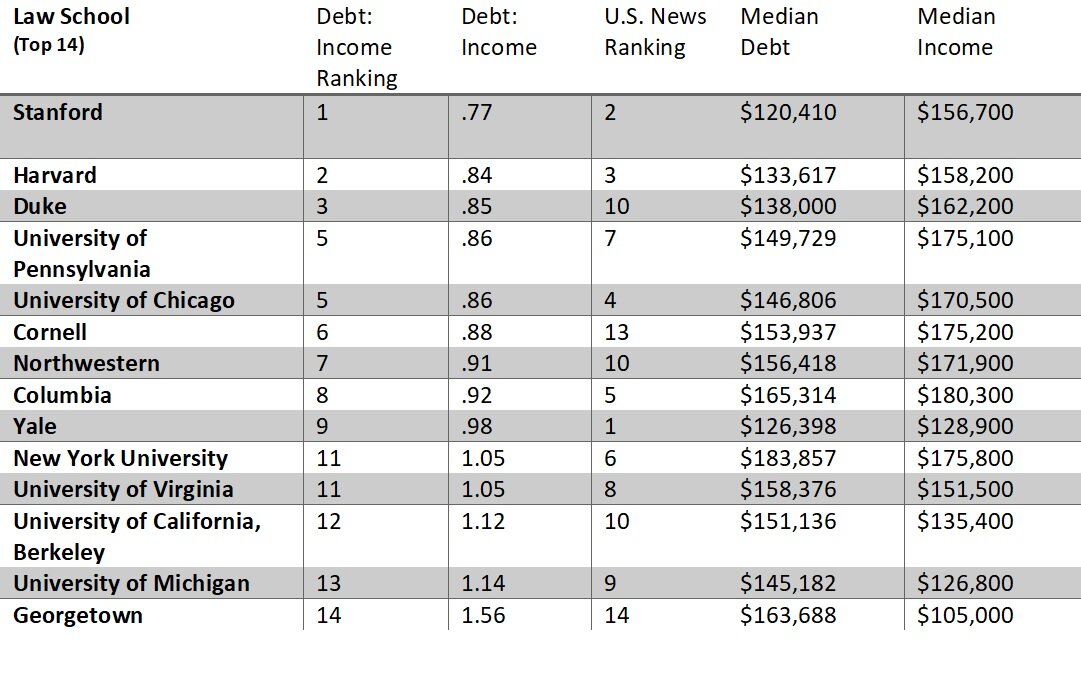
Late last week, the American Bar Association Journal reported that “most law students earn less money per year after graduation than the amount they borrowed for law school.” This is based off data recently released by the U.S. Department of Education. The article goes on to share that graduates from only 11 law schools reported higher median first-year earnings compared to median federal debt for graduates in 2015 and 2016. Further, the median debt-to-income ratio among law schools is 1.86, which means that graduates took out a median of 86 percent more in loans during law school than the median amount received in their first year working after graduation; median debt upon program completion for graduates was about $110,000 and median first-year earnings were about $53,000. 

Using the same Department of Education data, Law.com published a debt-to-earnings ratio for the U.S. News and World Report’s Top 14 law schools, as well as for New York-based law schools. We have compiled the data into some charts below for both the top-ranked, as well as NYC-based schools. They show the debt-to-income ratio, median first-year earnings for graduates, and median federal debt incurred for 2015 and 2016 graduates. It is important to note that these data points do not include private loans, loan interest, or borrowing for undergraduate or other graduate programs. So, the ratios may show slightly more positively than the full debt-load that many law school graduates are facing.

If you are considering law school, and you will be paying your own way through federal or other loan programs, you will want to assess this data during your school selection period. Ultimately the program that will best fit your needs should balance strong academic rigor and meaningful experiential learning opportunities with your future debt burden. The debt-to-income ratio rankings, as you can see, do not line up exactly with the school’s academic rankings, and the median debt and median earnings should be one of the many factors in your decision-making process. Additionally, these figures may provide insight into how much time you will want to spend researching fellowships and scholarship opportunities that can also ease the total cost of your schooling, particularly if you’re interested in pursuing lower paying career paths, such as public interest law.